
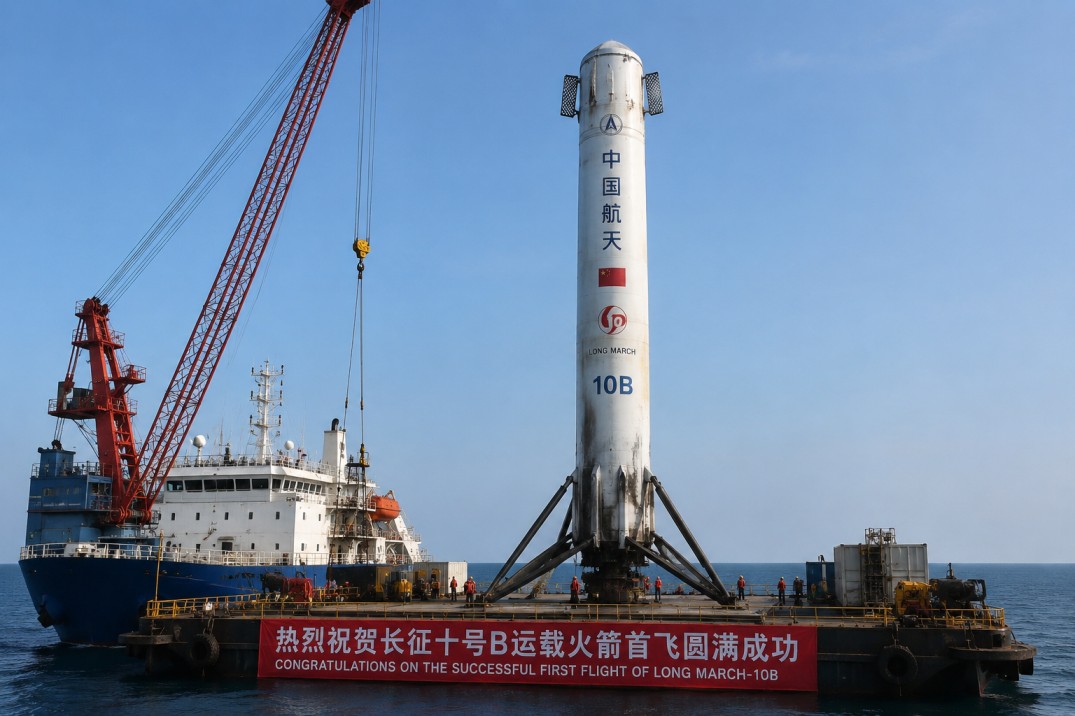
Marking a significant advancement in space technology, China has successfully retrieved its Long March 10B rocket after its inaugural orbital mission. This accomplishment positions China as the second country, following the United States, to exhibit dependable reusable orbital rocket technology. Such a feat underscores China’s growing prowess in the realm of space exploration and reusable launch systems.
The Long March 10B, standing at 63.6 meters, was launched from the Hainan International Commercial Aerospace Launch Center. The rocket’s ascent was powered by seven engines fueled by liquid oxygen and kerosene. Upon reaching a designated altitude, the rocket underwent stage separation, at which point the second stage took over, utilizing a liquid oxygen-methane engine to complete the mission and successfully deploy a satellite into its intended orbit.
In addition to the mission’s primary objectives, the operation also achieved a groundbreaking milestone in the field of space technology. It was the first time an orbital-class rocket was successfully recovered using a wire arrestment recovery system. This innovative method marks a notable stride in the evolution of reusable launch technology, further enhancing the capabilities of China’s expanding space program.
China’s latest achievement not only highlights the nation’s technological advancements but also signifies its commitment to advancing its space exploration endeavors. The ability to recover and potentially reuse orbital rockets could lead to more cost-effective and sustainable space missions in the future. This development aligns with global trends aiming for more efficient and environmentally friendly space travel.


