
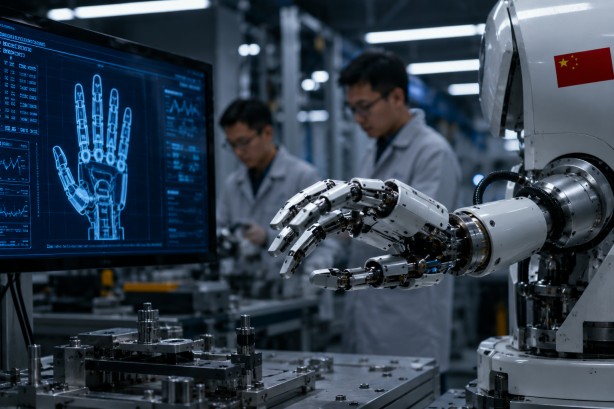
In China, robotics companies are ramping up their efforts to create highly skilled robotic hands, a technological frontier considered crucial for the advancement of humanoid robots. These robotic hands are being designed to execute intricate tasks such as grasping, tool usage, and managing daily activities, thereby enhancing the practical utility of humanoid robots in domestic, healthcare, and industrial environments.
Chinese startups are leveraging artificial intelligence in conjunction with the country’s robust manufacturing infrastructure to innovate in this challenging field. The development of these dexterous robotic hands involves overcoming both hardware and software hurdles. On the hardware front, engineers are tasked with designing compact motors and sensors, while the software must enable the robots to interpret sensory information related to touch, pressure, and complex motor functions.
Achieving the agility and precision of the human hand in robotic form is seen as a more formidable challenge than constructing other parts of humanoid robots. Nevertheless, China is positioning itself as a global leader in robotics manufacturing. This is facilitated by its advanced supply chains and a government-endorsed focus on “embodied AI,” which emphasizes the integration of AI with physical systems. The burgeoning robotics ecosystem in the country is fostering rapid innovation, with numerous companies developing not only robotic hands but also wearable sensor gloves and AI systems that learn human motions through real-world data.
Researchers in the field believe that enhancing the dexterity of robotic hands marks a significant advancement toward creating robots capable of performing a broad spectrum of everyday tasks. These tasks range from routine household chores to more complex industrial jobs and even advanced prosthetic applications. The ability to replicate human hand movements is likely to expand the functional applications of robots significantly.
Industry experts assert that the ongoing progress in AI and robotics could eventually lead to humanoid robots that operate seamlessly alongside humans. This evolution holds the potential to unlock new opportunities across various sectors, including manufacturing, healthcare, and consumer services, by enabling robots to perform tasks more naturally and efficiently.


