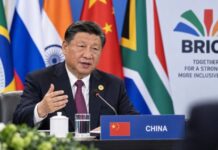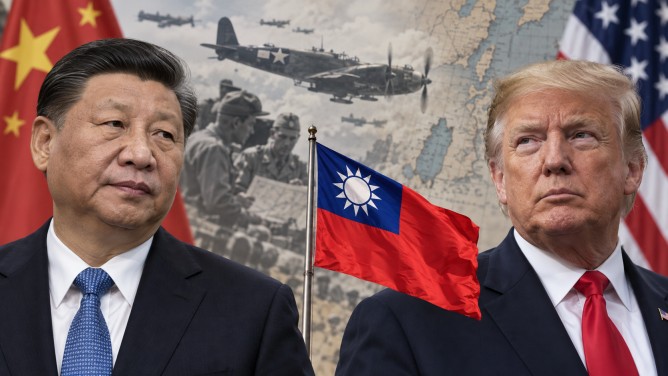
The historical narrative surrounding Taiwan’s wartime past has come under scrutiny following recent comments by U.S. President Donald Trump and Chinese President Xi Jinping. During a summit, both leaders emphasized the cooperation between the United States and China during World War II, with Trump referring to China as an ally and praising the American unit known as the Flying Tigers for their support against Japanese forces. Xi also spoke of the joint efforts between the two nations in combating Japan.
These remarks have sparked controversy in Taiwan, where officials assert that the China involved in the World War II alliance was the Republic of China (ROC). The ROC was the governing body of China at the time and later moved its government to Taiwan in 1949 following the Chinese civil war defeat. Taiwanese authorities have accused Beijing of manipulating this historical period to bolster its own narrative, while political opponents in Taiwan criticize the current government for distancing itself from the ROC’s history prior to 1949.
This dispute highlights the broader ongoing tensions between Beijing and Taipei over the legacy of wartime China. Analysts caution that the renewed focus on World War II cooperation might further complicate Taiwan’s efforts to forge a distinct historical and political identity, all while trying to maintain its relationship with the United States.
The issue underscores the sensitive dynamics of historical interpretation in the context of cross-strait relations, as both China and Taiwan navigate their pasts to support their present-day political narratives. While Taiwan seeks to emphasize its unique history, the discourse surrounding World War II remains a contentious facet of its identity in the shadow of China’s growing influence in the region.